


“Juana Inés de la Cruz. God make me a saint”.[1]
ABSTRACT
In this paper we argue that, thanks to the apostolic letter in the form of a “Motu Proprio” Maiorem hac dilectionem on the offering of life by Pope Francis, Sor Juana Inés de la Cruz fulfills the principal requirement established by the apostolic letter for being elevated to the altars of the saints in the Roman Catholic Church. Consequently, our argument will demonstrate that the holiness of Sor Juana Inés de la Cruz is rooted in the doctrine of the Ripalda catechism, as noted by her first biographer, Father Diego Calleja. Likewise, this paper is indebted to those writers who have defended, affirmed, and attested to the evangelical charity[2] of Sor Juana Inés de la Cruz.[3] Among these writers are: Father Diego Calleja, Lic. D. José de Jesús Cuevas, Alonso Junco, Ezequiel A. Chávez, General Vicente Riva Palacio, and Alejandro Soriano Vallès, among others.
INTRODUCTION
In this analysis we will argue that Sor Juana Inés de la Cruz is worthy of being elevated to the altars of the saints in the Roman Catholic Church because she fulfills the Christian virtues established by the Supreme Pontiff Francis in the apostolic letter in the form of a “Motu Proprio” Maiorem hac dilectionem on the offering of life. Accordingly, this essay will respond point by point to the recommendations of the first two paragraphs of the Motu Proprio. It will also respond to articles two, seven, and ten of the apostolic letter to demonstrate that “the offering of life”[4] made by Sor Juana Inés for her religious sisters is meritorious to be considered for her beatification and canonization, as established by Pope Francis in his apostolic letter. To prove our argument that Sor Juana Inés de la Cruz fulfills what is established in the Motu Proprio, we will rely on the biography of Mother Juana by Father Diego Calleja, the Ripalda catechism, and the Sorjuanista scholarship of Alejandro Soriano Vallès, among others.
THE “MOTU PROPRIO” MAIOREM HAC DILECTIONEM
The Supreme Pontiff Francis, in his apostolic letter in the form of a “Motu Proprio” Maiorem hac dilectionem on the offering of life, establishes a new path for the Causes of Saints. For a Christian person to be considered for beatification and canonization through this path, the letter requires that they exhibit certain Christian virtues. Thus, the first paragraph of the Motu Proprio states: “Worthy of special consideration and honor are those Christians who, following more closely the footsteps and teachings of the Lord Jesus, have voluntarily and freely offered their life for others and have persevered with this determination unto death”.[5] To present the candidacy of Sor Juana for her possible beatification and canonization, as established by Pope Francis in the apostolic letter, the Tenth Muse must fulfill the following conditions:
1. Whether Sor Juana Inés follows the footsteps and teachings of the Lord Jesus.
2. Whether Sor Juana Inés voluntarily and freely offers her life for others.
3. Whether Sor Juana Inés perseveres with this determination unto death.
To satisfactorily respond to these three initial points of the Motu Proprio, we will consult the first biography of Mother Juana written by Father Diego Calleja. We will also refer to the decontextualization of this biographical text by Alejandro Soriano Vallès, to demonstrate that Sor Juana fulfills the first requirement of the apostolic letter.
SHE FELL ILL FROM CHARITY
Father Diego Calleja, a Spanish Jesuit and epistolary friend of the Hieronymite nun, is the author of the first biography of Sor Juana Inés de la Cruz. This biography is undeniably the most important document available on the life of Mother Juana, because it provides hagiographic data relevant to the Motu Proprio. Father Calleja writes:
In this fervent intimacy with God—so desirable for awaiting death, for one who fears it not as the end of life but as the beginning of eternity—Mother Juana spent her final two years, until the end of 1695 arrived, most fruitful for heaven, which from the convent of San Jerónimo in Mexico City gathered a great harvest of most pure souls; one of these was, as devout reason might hope even without desiring it, that of Mother Juana Inés, who, like the bride in the Song of Songs in the presence of other flowers, fell ill from charity.[6]
Father Calleja’s assertion that Sor Juana “fell ill from charity”[7] is one of two Callejan declarations showing that the Hieronymite nun fulfills the requirement established in the apostolic letter for being declared a saint. To validate our argument, we will turn to the work of Alejandro Soriano Vallès (Aquella Fénix más rara) to excavate and extract the theological weight deposited behind Father Calleja’s delicate phrase, “she fell ill from charity”.[8] Soriano Vallès explains:
Indeed, Sor Juana, performing the work of a nurse caring for other nuns infected by the epidemic that had entered her monastery, likewise fell prey to it. But let us see how this beautiful expression from her proto-biographer, “she fell ill from charity,” quintessentializes the awestruck attitude of one who had already opened her eyes in the mists of mystery. At the beginning of this book, I said that every biography deciphers the life of a person from the vantage point of death—that is, from the totality—and that only from there can the data of one’s trajectory be read.
The Phoenix of America did not merely “fall ill” from charity in the sense of contracting the disease through her medical assistance work, but principally because her “illness” was charity itself, the practice of the teachings of the Master of mankind. Sor Juana, forgotten of herself in those days, was indicating without a shadow of doubt the End of her existence: the interiorization of the absolute enigma, which demands unconditional surrender for the sake of the fullest of freedoms—the knowledge of the intimate Life of God. This End is not only a goal, but an Origin, because from it the path becomes clear and explicit, as it was traced from the beginning of time. Mother Juana’s “illness” is then called God; Wisdom always beloved by her, who had to wait for that instant, the boundary with death, to receive its full name. Sor Juana always died—even in the sublime state of her Dream—of God. But she had to arrive here to acknowledge it without hesitation.[9]
We will continue consulting Soriano Vallès’ text, Aquella Fénix más rara, to respond to the first points of the first paragraph of the apostolic letter. We begin:
1. Whether Sor Juana Inés follows in the footsteps and teachings of the Lord Jesus.
Response: “The Phoenix of America did not merely ‘fall ill’ from charity in the sense of contracting the disease through her medical assistance work, but principally because her ‘illness’ was charity itself, the practice of the teachings of the Master of mankind”.[10]
2. Whether Sor Juana Inés voluntarily and freely offers her life for others.
Response: “Sor Juana, forgotten of herself in those days, was indicating without a shadow of doubt the End of her existence: the interiorization of the absolute enigma, which demands unconditional surrender for the sake of the fullest of freedoms—the knowledge of the intimate Life of God”.[11]
3. Whether Sor Juana Inés perseveres with this determination unto death.
Response: “Mother Juana’s ‘illness’ is then called God; Wisdom always beloved by her, who had to wait for that instant, the boundary with death, to receive its full name. Sor Juana always died—even in the sublime state of her Dream—of God. But she had to arrive here to acknowledge it without hesitation”.[12]
In Aquella Fénix más rara, Soriano Vallès demonstrates that Mother Juana makes “the offering of life”[13] for her sisters through “charity, the practice of the teachings of the Master of mankind”.[14] In this way, Sor Juana fulfills the preliminary phrase of the apostolic letter.
DEUS CARITAS EST
In the encyclical letter Deus caritas est (God is Love), Pope Benedict XVI speaks about the Greek concept of ‘agape’. For Benedict XVI: “the word agape indubitably denotes something essential in the novelty of Christianity, precisely in its way of understanding love”.[15] The Pope then broadens the definition of love within the Christian context, stating: “Now love is concern for the other and solicitude for the other. It no longer seeks itself, to sink into the intoxication of happiness; it desires instead the good of the beloved: it becomes renunciation and is ready for sacrifice, indeed it seeks sacrifice”.[16] As Pope Benedict XVI explains, love can be understood as a sacrifice. Therefore, Mother Juana, in caring for her religious sisters, fulfills this sacrifice that Christian love demands—for we already know that Sor Juana “fell ill from charity”.[17] In Sor Juana Inés de la Cruz. Doncella del Verbo, Soriano Vallès explains:
The Sor Juana who ‘awakens’ at the end of the work is thus the woman who has arrived, perhaps around the age of thirty-seven, at one of the summits of spiritual life: the recognition that happiness is not found in knowledge, which is already to cross the threshold of wisdom. Primero sueño appears in this way not only as Sor Juana’s most personal work, but also, by that same token, as the poetic mark of the superior spiritual stage that—from that moment onward—is perceptible in her, and whose conclusion will be the final surrender of Christian agape: the life given in service to her sick sisters.[18]
Through the Christian virtue of caritas-agape, “the offering of life”[19] of Mother Juana takes its true course. In other words, the Tenth Muse’s sacrifice is an act of charity. Moreover, one of the definitions of charity in the Dictionary of the Spanish Language is “to love God above all things, and one’s neighbor as oneself”.[20] It is our view that Sor Juana—through her charitable likeness—embodies the very definition of charity. With this, we conclude our responses to the first paragraph of the Motu Proprio.
CHARITY
In the second paragraph of the apostolic letter, charity is identified as the Christian virtue that sustains “the heroic offering of life”.[21] Consequently, the thesis of the Motu Proprio is “the heroic offering of life”[22] through Christian charity. But let us enter the letter itself to better appreciate the full meaning of this second paragraph:
Certainly the heroic offering of life, inspired and sustained by charity, expresses a true, complete, and exemplary imitation of Christ, and thus is deserving of that admiration that the community of the faithful customarily reserves for those who have voluntarily accepted the martyrdom of blood or who have exercised Christian virtues to a heroic degree.[23]
To better identify and respond to what is set forth in the second paragraph of the Motu Proprio, we will divide it into the following four points:
1. Whether Sor Juana’s offering of life is heroic.
2. Whether Sor Juana’s offering of life is inspired and sustained by charity.
3. Whether Sor Juana’s offering of life expresses a true, complete, and exemplary imitation of Christ.
4. Whether Sor Juana’s offering of life is deserving of the admiration of the community of the faithful.
To respond with greater precision to these four points, we will refer to the testimonies of Alfonso Junco, Amado Nervo, Alejandro Soriano Vallès, Julio Jiménez Rueda, and Fathers Diego Calleja and José de Jesús Cuevas. Before proceeding, however, we must warn the readers that extensive direct quotations follow. The reason for such lengthy quotations is Pope Francis’s own recommendation.[24] We begin:
1. Whether Sor Juana’s offering of life is heroic.
Response: “Then, a severe epidemic made its way into the convent of the Hieronymites, and Sor Juana Inés—always luminous with sympathy and kindness toward her sisters—heroically persisted in her service and ultimately became infected and died. It was April 17, 1695”.[25]
Response: “And so, flying in perfection, attaining through the heroic effort of her spirit the absolute negation of herself, the mother spent her final two years, and reached the beginning of 1695, in which, according to her biographer’s beautiful phrase, ‘she fell ill from charity’”.[26]
Response: “Always, but above all from this moment onward, we must recall Calleja’s categorical words regarding the moral nature of our heroine: ‘charity was her ruling virtue’”.[27]
2. Whether Sor Juana’s offering of life is inspired and sustained by charity.
Response: “She sold her mathematical and musical instruments that adorned her cell and arranged for the proceeds to be distributed among the poor. She signed with her blood a ratification of the vows she had made upon entering the convent. She renewed her profession of faith. She reconciled with Father Antonio Núñez de Miranda, her confessor since she was a girl at the Viceroy’s court, and her yearning for perfection was such that her confessor himself once exclaimed: ‘It is necessary to mortify her so that she does not mortify herself too much, restraining her penances, lest she lose her health and become incapacitated; for Juana Inés does not walk in virtue—she flies.’ She fulfilled her duties within the community with efficiency, solicitude, and ardent charity. In her spirit, the ‘I die because I do not die’ of Saint Teresa of Jesus had been indelibly fixed”.[28]
Response: “In this fervent intimacy with God—so desirable for awaiting death, for one who fears it not as the end of life but as the beginning of eternity—Mother Juana spent her final two years, until the end of 1695 arrived, most fruitful for heaven, which from the convent of San Jerónimo in Mexico City gathered a great harvest of most pure souls; one of these was, as devout reason might hope even without desiring it, that of Mother Juana Inés, who, like the bride in the Song of Songs in the presence of other flowers, fell ill from charity”.[29]
Response:[30] “When Juana saw her sisters stricken by the plague, the love she bore them caused her to emerge from the retreat of her contemplation, to throw herself, armed with her charity, into the holy battle to which heaven called her. She abandoned the seclusion of her cell, to fly to the bedside of her sick sisters. Trials hold for virtuous souls the same inexplicable attraction that difficulties hold for genius, and dangers for valor. The contagion was so severe and Juana so beloved, that all implored her to preserve herself—the community’s most precious jewel—and to take at least some precaution in her favor, moderating the zeal and assiduity with which she practiced one of the holiest, yet most arduous, works of mercy toward one’s neighbor. These pleas, so full of affection and sincerity, she acknowledged with gratitude, but they only served to inflame her charity further”.[31]
3. Whether Sor Juana’s offering of life expressed a true, complete, and exemplary imitation of Christ.
Response: “It was love, not wisdom, or more precisely, the wisdom of love, that led her—as it led her Master—to give her life for many”.[32]
Response: “Juana had breathed her last. Her face—white and beautiful as a fragment of a marble statue from ancient Greece—had not yet been veiled when the dawn of April 17, 1695 began to break, the Sunday of the Good Shepherd, of the infinitely merciful Shepherd who gave his life for his sheep. Juana died on the day the Church celebrates the infinite greatness of the Lord’s mercies. She breathed her last just before daybreak. Perhaps, in the space between, her ascending soul and the descending dew met… God in His immense goodness would receive her into His bosom… Beati illi qui in Domino moriuntur!…”.[33]
(Blessed are those who die in the Lord).
4. Whether Sor Juana’s offering of life is deserving of the admiration of the community of the faithful.
Response: “Let us review, savoring them, the words of Oviedo: Sor Juana Inés de la Cruz left ‘this entire city more edified by her heroic resolution and singular examples of virtue than it had been amazed by her genius, writings, and talents.’ ‘To edify’ means, according to the Dictionary of the Royal Spanish Academy, ‘to instill in someone feelings of piety and virtue.’ This is what the Maiden of Nepantla inspired in her compatriots, who knew what had been occurring for years behind the walls of the convent of San Jerónimo. That favored nature, so praised for her intellectual gifts and beloved for her affability and charm, was now venerated in the capital of New Spain on account of the manner of life with which, scorning the honors of the world, she had given herself entirely to her Master in the persons of others. The Church of Mexico, through its shepherd and by means of the indulgence granted to the readers of the Protesta de la fe, proposed her as a model worthy of imitation. The heroic ending of her life was in truth edifying, and above all because of the audacity of her self-abnegation. Sor Juana was admired for her charity—the root of the theological virtues”.[34]
We are indebted to the writers previously cited. Their impeccable research, writings, and subtle reflections on the life of Mother Juana have made it possible for us to respond satisfactorily to the first and second paragraphs of the Motu Proprio. We now present articles two, seven, and ten of the apostolic letter.
THE SECOND ARTICLE OF THE APOSTOLIC LETTER
The apostolic letter in the form of a Motu Proprio contains several articles. We do not intend to respond to each of them—that task lies beyond our scope. But we will respond to three of the letter’s articles. We begin with the second article, which establishes the following: “The offer of life, in order that it be valid and effective for the beatification of a Servant of God, must respond to the following criteria”:
a) a free and voluntary offer of life and heroic acceptance propter caritatem of a certain and untimely death;
b) a nexus between the offer of life and premature death;
c) the exercise, at least as ordinarily possible, of Christian virtues before the offer of life and, then, unto death;
d) the existence of a reputation of holiness and signs, at least after death;
e) the necessity of a miracle for beatification, occurring after the death of the Servant of God and through his or her intercession.[35]
It must be noted that Sor Juana is not a Servant of God within the Roman Catholic Church. Nevertheless, the Tenth Muse fulfills the alphabetical classification of this second article. We will therefore refer to the testimonies of Amado Nervo, Ezequiel A. Chávez, and Father Calleja to show that Sor Juana satisfies the five points of this second article. We begin:
a) On the free and voluntary offering of life and heroic acceptance propter caritatem of certain and imminent death.
Response: “And so, flying in perfection, attaining through the heroic effort of her spirit the absolute negation of herself, the mother spent her final two years, and reached the beginning of 1695, in which, according to her biographer’s beautiful phrase, ‘she fell ill from charity’”.[36]
Response: “She then flew to the aid of all, free at last to emerge from the prison of herself, to go beyond herself in search of those who needed her, as she went with loving will and untiring gentleness, until she fell ill and died, at four in the morning on April 17, 1695: two months after her confessor, Father Antonio, had preceded her, also a victim of the plague”.[37]
Response: “A pestilential epidemic entered the convent, of such virulence that of every ten nuns who fell ill, barely one recovered. The disease was, alas, highly contagious. Mother Juana, of a most compassionate and charitable nature, attended to all without tiring of the continual duty or fearing the proximity of the sick. To tell her then—as so many advised her—to at least keep away from those most afflicted, was to fit her with the wings of a bee, to make her flee from the flowers. She finally fell ill, and the moment her danger was recognized, the convent and the city filled with prayers and offerings for her health; she alone was reconciled to the hope of her death that all feared. The medicines were very continuous and arduous, which Mother Juana bore as though chosen and no different in their arduousness from her penances. She received the Sacraments with great devotion and in the Eucharist showed confidence of great tenderness, bidding farewell to her Spouse until they would soon be reunited. The severity of the illness, sufficient to take her life, could not cause her the slightest disturbance of understanding, and, like a faithful friend, it kept her company until her final sighs, which, having received Extreme Unction, she exhaled, already cold and slow; all but her ejaculatory prayers to Christ and His blessed Mother, which she never removed from her hand or her lips. She showed at last how prepared she was in all things, responding very aptly and punctually to the prayers of the commendation of the soul which, completed, returned hers—not only with serene conformity, but with vivid signs of desire—into the hands of her Creator, at four in the morning, on the seventeenth of April, Sunday of the Good Shepherd, in the year 1695”.[38]
b) On the nexus between the offering of life and premature death.
Response: “At the age of 43, when she was in the fullness of life and still had a vast field to traverse, Sor Juana Inés succumbed, victim of an epidemic that invaded the convent she inhabited. Her premature death was universally mourned by men of letters in both Spain and Mexico”.[39]
c) On the exercise, at least as ordinarily possible, of Christian virtues before the offer of life and, then, unto death.
Response: “Once the fathers of her learned and holy family asked Father Antonio Núñez how Mother Juana was faring in her yearning for perfection. And he replied: it is necessary to mortify her, so that she does not mortify herself too much, restraining her penances, lest she lose her health and become incapacitated; for Juana Inés does not walk in virtue—she flies”.
In this fervent intimacy with God—so desirable for awaiting death, for one who fears it not as the end of life but as the beginning of eternity—Mother Juana spent her final two years, until the end of 1695 arrived, most fruitful for heaven, which from the convent of San Jerónimo in Mexico City gathered a great harvest of most pure souls; one of these was, as devout reason might hope even without desiring it, that of Mother Juana Inés, who, like the bride in the Song of Songs in the presence of other flowers, fell ill from charity”.[40]
d) On the existence of a reputation of holiness and of signs, at least after death.
Response: “The bells of the convents were ringing rogations for her health when she, shortly before sunrise, died. Before the fleeting aurora over her convent and over the old capital of New Spain, her soul dawned then in the eternal dawn; and then also, all who had persecuted her with their murmurs, their prejudices, their unjust appraisals, felt themselves at last defeated. Saint, they all said; and in Latin and in Castilian, in verse and in prose, all praised her; all exalted her gifts”.[41]
Response: “The majority of the panegyrists who participated in Fama y obras póstumas, both the Spanish and the Novohsipano, agree that through her sacrifice Sor Juana attained eternal life and they admire her for it. The preacher and chaplain of honor to His Majesty, archbishop-elect of the Philippines and bishop-elect of Naples, Ignacio Muñoz de Castilblanque, a great admirer of hers, after referring to her widespread fame, reflects on the renunciations she made out of love for God, which served to save her soul. He considers exemplary the manner in which she lived during her final years and concludes that ‘true wisdom [is] to use it toward the end that matters most’.
Marcial de Benetasua Gudeman praises Sor Juana’s genius as much as her virtues, and—addressing her directly—says: “blessedly did your labors end, granting joy even to death itself”; and because she obtained a holy death, he places her in heaven and tells her that “of your fair soul, in its pure candor, luminous remained the ashes […] of the glorious eternity you inhabit.” Antonio Deza y Ulloa, an official of the Tribunal of Accounts of Mexico, affirms that “she died more from understanding than from human frailty,” and metaphorically compares her to an exploding volcano, whose snow was melted by the “giant flame” of her love for God. An anonymous poet (supposedly a friend of Calleja), author of the sonnet “To the Disillusion with which Mother Juana Inés de la Cruz Died,” praises her decision to “disillusion herself” from the worldly in order to devote herself to the eternal. Luis Muñoz Venegas y Guzmán imagines her in heaven and tells her: “enjoy, in beatitude, the goods that your death takes from the world: sweetness, clarity, life, and calm.” Juan de Bolea Alvarado admires both the wisdom she attained—enough to earn “heroic” fame—and her ability to “disillusion herself” from worldly vanities and prepare for death: “And since you knew so wisely how to live, who doubts that you trained yourself to die? Our breathing is the peril of life, but your life was the study of death.” Gerónimo Monforte y Vera shares Calleja’s idea that it was God who returned Sor Juana to the right path. He believes she had been lost in the “chaos of life,” in a “doubtful, tangled labyrinth […], on the precipice of the world,” but upon hearing the voice of God—who, like the Good Shepherd, called her—she left behind “life, learning, hope, and the world” to follow Him as a loving sheep”.[42]
Nevertheless, it is Amado Nervo who best responds to the question of the “existence of a reputation for holiness and signs thereof, at least after death”[43] of Sor Juana Inés de la Cruz.
Response: “That is to say, Sor Juana was not at that time a saint, if we are to gloss the foregoing words (though it is added immediately after that ‘charity was her ruling virtue’ and Ripalda himself asks: who before God is the greatest and holiest? And he answers: ‘Whoever has the greatest charity, whoever that may be’). But if she was not yet a saint (for she became one, within the devout estimation of her contemporaries, in the final years of her life, of which we will speak separately), she did faithfully comply with the rule”.[44]
Moreover, it is Amado Nervo who discovers the semantic depth deposited in Father Calleja’s expression “she fell ill from charity”[45] within the Ripalda catechism. Therefore, before concluding with the fifth and final point of the second article, we will examine the catechism and its impact on the young Juana Inés and her world.
THE CATECHISM
The Ripalda Catechism was first published in 1591 under the title Catechism of Christian Doctrine by Father Gerónimo Ripalda, S.J. The format of the catechism is simple, composed mainly of questions and answers. Without any specific order, we present the questions and answers concerning charity in the Ripalda catechism:
Q. What is Charity?
A. To love God above all things and one’s neighbor as oneself.[46]
Q. Who among men is the holiest?
A. Whoever has the greatest charity, whoever that may be.[47]
Q. And who has the greatest charity?
A. Whoever best keeps the Commandments.[48]
Q. What is charity as a fruit?
A. The act of love of God and of neighbor.[49]
Let us recall that Father Calleja makes two declarations regarding the charitable likeness of the Hieronymite nun. In the first, the Jesuit reveals that in Mother Juana “charity was her ruling virtue”.[50] With this assertion, Father Calleja perhaps alludes to the First Epistle of the Apostle Saint Paul to the Corinthians, chapter thirteen, verse thirteen (1 Cor, XIII:13). The Jerusalem Bible reads: “And now faith, hope, and charity remain, these three; but the greatest of all is charity”.[51] That is to say, Father Calleja subtly proposes that, of the three theological virtues—faith, hope, and charity—in Sor Juana Inés de la Cruz, charity is the greatest of her Christian virtues. With his second declaration, Father Calleja affirms that the Hieronymite nun “fell ill from charity”.[52] In this case, the Jesuit priest points to the holiness of Sor Juana through the questions and answers of the Ripalda catechism. Thus, Father Calleja’s intention is to plant the saintliness of Sor Juana within the Christian doctrine of Father Ripalda.
THE RIPALDA CATECHISM AND THE HISPANIC WORLD
For three centuries, Ripalda’s Christian doctrine was the catechism that instructed the Hispanic world. This catechism must therefore be an obligatory reference in any study of Mother Juana’s religious life. In Imágenes de la tradición viva, Carlos Monsiváis explains:
The Jesuit priest Jerónimo Martínez de Ripalda was born in Spain in 1536 and died in 1618. His didactic work on Christianity, Catechism and brief exposition of Christian doctrine with a very useful treatise on the order in which the Christian should occupy their time and employ the day (Burgos, 1791), quickly became the most widely distributed text of its kind in the Spanish-speaking world. It begins with verses intended to be recited in the church, the home, and the solitude of the conscience.[53]
In this way, New Spain’s societies were instructed in Father Ripalda’s Christian doctrine, and the young Juana was no exception. In her work Humanismo y religión en Sor Juana Inés de la Cruz, Marié-Cécile Benassy-Berling comments:
Nevertheless, there is moral certainty that Sor Juana read Ripalda, at least when she was a child; not only was it a foundational work in the Hispanic world for several centuries, but in 1690 a Mexican Jesuit alluded to its wide circulation in the capital.[54]
Likewise, in his work Sor Juana Inés de la Cruz Literary Study Dedicated to the Ladies of the Catholic Society, Dr. José de Jesús Cuevas elaborates on the catechism’s impact on the religious formation of the young Juana. Father Jesús Cuevas writes:
The book that probably carved in her intelligence the channel through which her thoughts began to flow was the manual catechism with which for more than two centuries the Catholic Church has suckled in holy doctrine all those who speak the Spanish tongue: that incomparable compendium of Christian doctrine, written by Father Ripalda, which, approved by one of our first councils to be the text of common instruction in all the vast New Spain, for more than two centuries has been learned in all our schools, and all mothers teach it to their children when the first light of reason dawns in them.
This holy little book cannot be mentioned without very great emotion; in it we all learned to be Christians. It merges in our imagination with the most gratifying and moving memories of our childhood: in the memory of all it is identified with the tender accent of our mothers, with the first words we stammered, with the first stirrings of our hearts and the first prayers our lips pronounced. This venerable book is an inexhaustible treasure of knowledge, of emotions and memories. Not only is it imperishable for the everlasting doctrine it contains, but in itself and by its form it seems destined to arrive in waves of centuries to the very ends of time. It will survive in the world even when the expansive language we possess is lost in it. It is without doubt the great book our tongue has produced……
Leaving aside the Holy Scriptures—whose pages, directly inspired by the Holy Spirit, are not to be compared but rather prayed, meditated upon, and kissed—and after the Imitation of Christ, which, according to Leibniz’s expression, is the book most filled with the Spirit of God after the Sacred Bible, the most prodigious product of the human spirit, whose very simplicity seems almost inspired, the most wondrous production of the human mind in its own genre is the humble Catechism of Father Ripalda. A sublime alphabet of a divine science, there is no revealed, social, or philosophical truth that it does not contain: whoever possesses it holds in his hands the key to the loftiest knowledge that the human spirit may reach in its final ascent. Father Ripalda, the Albrecht Dürer of Christian essence, engraved in steel—with exquisite delicacy of execution—the highest principles of the highest theology; a sublime miniaturist of Catholic doctrine, he caused the most grand and exalted truths of the science of sciences to descend to the weak understanding of children and the rough minds of the ignorant. The person who best engraves this book upon his understanding will be the wisest; and the one who, with God’s grace, best engraves it upon his heart will be the happiest of mortals, and after this life will possess eternal beatitude. If making so simple a doctrine so grand and sublime were not the constant miracle that the Divinity works in our favor, the existence of Christian catechisms—of the kind written by the discreet and pious spiritual director of Saint Teresa of Jesus—would be inexplicable.
This holy book from which we all drank the waters of true life was also probably the first to nourish the spirit of Juana and to sow in it the seeds of truth that later were to produce in her so many flowers and so many fruits. The comments that Father Fray Francisco Muñiz must have made on this sublime text during his doctrinal talks—he being the solicitous pastor of the district in which Juana lived—would likely have completed the foundations of her heart and her understanding. Father Muñiz was an illustrious Dominican who, in the year 1651, attended the general consistory held in Spain by his Order, and who wrote, in praise of learning and virtue, the life of Saint Francis Borgia, one of the generals of the Society of Jesus. Having returned to his parish, he must have tended his flock with the apostolic word, spoken in the simple tone of the ancient homilies— that eloquence of the primitive Church which today would perhaps not suffice to counter the lofty rhetoric and proud sophisms of our times.
The sublime truths of our august beliefs, conveyed by Father Muñiz with that moving simplicity with which the ancient Holy Fathers of the Church addressed their tender flocks, must have fallen upon Juana’s gentle intelligence like the dew of dawn upon the delicate leaves of flowers, leaving in her an indelible seal that fixed forever the character of her spirit. Purity of heart and thought, elevation of soul and spirituality of sentiment, to think and to feel deeply—this was, from the moment her early reason began to shine, the singular character of her existence.
Such was Juana’s intellectual childhood. It is the childhood of her spirit that must draw our attention, for her biography cannot be the history of a woman; it is, and must be, the transparent unfolding of a great soul.[55]
Through the Ripalda catechism, the charitable portrait of Sor Juana takes on its broadest meaning. With this, we conclude our analysis of the catechism’s influence on Sor Juana and her world. We now return to answering the final letter of the alphabetical classification of the second article.
SERVANT OF GOD
The fifth and final point of the second article concerns “the necessity of a miracle for beatification, occurring after the death of the Servant of God and through his or her intercession”.[56] Let us recall that Sor Juana Inés is not a Servant of God in the Catholic Church. Furthermore, article thirty-six of the apostolic letter cautions the following:
Any solemn celebrations or panegyrics speeches about Servants of God whose sanctity of life is still being legitimately examined are prohibited in Churches. Furthermore, one must also refrain, even outside of Church, from any acts which could mislead the faithful into thinking that the inquiry conducted by the Bishop into the life of the Servant of God and his virtues or martyrdom or offering of life carries with it the certitude that the Servant of God, will be one day canonized.[57]
This paper adheres to the warnings and recommendations of the Motu Proprio. Nevertheless, the Episcopal Church of the city of Los Angeles, California, does count Sor Juana Inés de la Cruz as a Servant of God and commemorates her on April 18 within its liturgical calendar.[58] The Episcopal liturgy likewise contains two prayers in her honor:
Rite I:
Almighty God, Source of all knowledge, we give thee thanks for the witness of thy servant Juana Inés de la Cruz in her fierce passion for learning and creativity. Teach us, we beseech thee, so to be faithful stewards of our minds and hearts, that, following her example, we might forever proclaim the riches of thine unending love in Christ Jesus our Lord. Through the same Jesus Christ who, with thee and the Holy Ghost, livest and reingest for ever and ever. Amen.[59]
Rite II:
Almighty God, Source of all knowledge, we give thanks for the witness of your servant Juana Inés de la Cruz in her fierce passion for learning and creativity. Teach us to be faithful stewards of our minds and hearts, so that, following her example, we might forever proclaim the riches of your unending love in Jesus Christ our Lord. Through Jesus Christ who, with you and the Holy Spirit, lives and reigns, one God, for ever and ever.[60]
To a lesser extent than the Episcopal Church, the Catholic Church also invokes Sor Juana Inés in its communal prayer of the Divine Office. Soriano Vallès explains:
Although anonymously, for decades the Church in Hispanic America has treasured in the devotion of the Breviary (today called the Liturgy of the Hours) and, consequently, as part of its public and official prayer, the poetry of Sor Juana Inés de la Cruz. Effectively, as Ana Lorenia García pointed out to me, in the Vespers of August 22, the feast of Saint Mary Queen, the Hymn “De hermosas contradicciones” is included, formed by verses (slightly modified) belonging to number III of the Villancicos of 1679 dedicated to the Assumption of the Virgin:
With beautiful contradictions
we see you, Queen, adorned,
too much a woman to be divine,
too heavenly to be human.
With admiration, in her
the law is seen abrogated,
too humble to be Queen,
too free to be a slave.
Her troops hold her
as leader of the heavenly squadrons,
too tender to do battle,
too young to be so armed.
The dignity she enjoys
wars with her modesty,
too small to command,
too lofty to humble herself.
She unites in her divine eyes
fear with confidence,
too terrible to be beautiful,
too beloved to inspire awe.
Placed in the empyrean,
in the heavenly dwelling,
a narrow throne for her greatness,
too grand a palace for her humility. Amen.[61]
Furthermore, on social media, the digital channel Catholicae Academiae records the following note: “Sor Juana Inés de la Cruz again in her home: the Catholic Church. On the eve of the birth anniversary of our Sor Juana Inés de la Cruz, on November 11, 2023, the Catholic Church in Wilmington, California honored Sor Juana during her solemn vespers with baroque music from the Viceroyalty of New Spain”.[62] With the content of Catholicae Academiae we conclude the second article of the apostolic letter. We now present articles seven and ten of the Motu Proprio.
ARTICLES SEVEN AND TEN
Article seven of the apostolic letter in the form of a Motu Proprio stipulates: “A cause can be recent or ancient. It is called recent if the martyrdom or virtues or the offering of life of the Servant of God can be proved through the oral depositions of eye witnesses; it is ancient, however, when the proof for martyrdom or the virtues can be brought to light only from written sources”.[63]
Throughout this paper, we have presented written sources. Therefore, Mother Juana’s cause is ancient. Article ten stipulates the following:
“[I]n both recent and ancient causes, a biography of any historical import of the Servant of God, should such exist, or otherwise an accurate, chronologically arranged report on the life and deeds of the Servant of God, on his virtues or on his offer of life or martyrdom, on his reputation of sanctity and of signs. Nor should anything be omitted which seems to be contrary or less favorable to the cause”.[64]
Sor Juana Inés de la Cruz has two major biographies. The first is Vida by Father Calleja, published in 1700, and the second is Sor Juana Inés de la Cruz. Doncella del Verbo by Alejandro Soriano Vallès, published for the first time in 2010. Both works satisfy the historical rigor demanded by the tenth article. However, Doncella del Verbo is the most complete and historically rigorous biography of Sor Juana currently in existence. Regarding this masterful work, the Fondo Editorial Estado México (FOEM) states:
Since its first edition, Sor Juana Inés de la Cruz. Doncella del Verbo has charted the course of studies dedicated to the Tenth Muse. It opened new avenues of research not only for the rigor with which it approaches its protagonist’s work, but also because it broadens the analysis of her social relationships and environment and brings to light numerous previously unknown documents. The seriousness and depth with which Alejandro Soriano Vallès examines both the life and work of the Mexican poetess and the cultural context in which it developed, as well as the principal interpretations of specialized criticism, make this book not only the best biography of Sor Juana in the last forty years, but also an indispensable instrument for those who, beyond fashionable historical fiction, wish to know the true face and era of the Phoenix of America.[65]
In Doncella, Soriano Vallès argues in favor of the holiness of Sor Juana “without omitting whatever may seem contrary or less favorable to the same cause”.[66] For this reason, we have focused on the work of Soriano Vallès to respond to the majority of the conditions demanded by the Motu Proprio. Finally, we will turn to the epigraph of the Motu Proprio to conclude with the apostolic letter.
JOHN 15:13
It is in the epigraph of the apostolic letter that the only biblical passage is found. It belongs to the Gospel of Saint John, chapter fifteen, verse thirteen (Jn, XV:13). There, the Apostle John tells us: “Greater love has no man than that a man lay down his life for his friends”.[67] Remarkably, Soriano Vallès addresses this Johannine quotation and completes the charitable portrait of Sor Juana Inés. In Doncella del Verbo, Soriano Vallès explains:
Ah, she fell ill from charity, she whose affection had always been magnanimity! No one has greater love than this, to lay down one’s life for one’s friends (Jn, XV:13), and Sor Juana Inés de la Cruz, Bride of Christ, Maiden of the Word, being the archivist, the accountant (and, in the eyes of the world, much more: the celebrated poet, the laureate intellectual), rolled up her habit to go to the infirmary in aid of those who were suffering.[68]
Seven years in advance, Alejandro Soriano Vallès prefigured the apostolic letter in the form of a Motu Proprio. Thus, Doncella del Verbo and the apostolic letter complement each other. That said, Rome and the Catholic Church in Mexico will find in Soriano Vallès’s work the documentary evidence needed to beatify and canonize Sor Juana Inés de la Cruz.
MEXICAN LIBERALISM
We have concluded our analysis of and responses to the apostolic letter in the form of a “Motu Proprio” Maiorem hac dilectionem on the offering of life by the Supreme Pontiff Francis regarding the beatification and canonization of Sor Juana Inés de la Cruz. However, it must be acknowledged that there are Sorjuanista scholars of a secular and humanistic profile who oppose the canonization of Sor Juana. Among them are Darío Puccini,[69] Octavio Paz,[70] and Margo Glantz.[71] The thesis of Puccini, Paz, and Glantz is that Sor Juana is not a saint of the Catholic Church but rather a woman persecuted and censored by the powerful hierarchs of the Catholic Church. However, the thesis of the apostolic letter is that the person under consideration for beatification and canonization must demonstrate the Christian virtue of “the offering of life”.[72] In this case, Mother Juana fulfills the requirement of the apostolic letter because she offers her life through the Christian virtue of caritas-agape (love of neighbor). In his biographical text about the Hieronymite nun, El Parnaso Mexicano Sor Juana Inés de la Cruz su retrato y biografía con el juicio crítico de sus obras y poesías escogidas de varios autores, the liberal and enlightened Don Vicente Riva Palacio affirms:
Twenty-seven years she remained in her Convent, and in that same retreat she died, greatly mourned, at the age of 44, victim of her ardent evangelical charity, infected by a pestilential fever that had made itself felt in the Capital of the Viceroyalty, and which had entered the cloister where Sor Juana dwelt. Through attending with the utmost assiduity and the most heartfelt affection to her sisters in religion, she succumbed, surrendering her noble, ardent, and elevated spirit to the Supreme Creator, who had showered her with so many and such great gifts.[73]
What a beautiful expression General Vicente Riva Palacio leaves us regarding the charitable virtue of Sor Juana—“victim of her ardent evangelical charity”.[74] With this phrase by General Palacio, nineteenth-century Mexican liberalism aligns with the thought of Father Diego Calleja and the Ripalda catechism: that Sor Juana, by virtue of her evangelical charity, fulfills the requirement established by the apostolic letter of the Supreme Pontiff Francis for her beatification and canonization.
CONCLUSION
The testimonies of Father Diego Calleja, Lic. D. José de Jesús Cuevas, Alonso Junco, Julio Jiménez Rueda, Ezequiel A. Chávez, Vicente Riva Palacio, and Alejandro Soriano Vallès that we have cited throughout this paper were written centuries and years before the publication of the apostolic letter in the form of a Motu Proprio. Consequently, the quotations have not been manipulated to conform to the demands of the apostolic letter. On the contrary, Father Diego Calleja, the Ripalda catechism, Vicente Riva Palacio, Alejandro Soriano Vallès, and the Motu Proprio complement one another, for “the offering of life”[75] of Mother Juana follows “the teachings of the Lord Jesus”.[76] And the teaching of the Lord Jesus is that “No one has greater love than this, to lay down one’s life for one’s friends”.[77] And our Sor Juana Inés de la Cruz fulfills this divine commandment of offering her life for her religious sisters, for “charity was her ruling virtue”.[78] May God make her a saint![79]
Authors:
Juan A. Tavárez
Compton College, California
Claremont Graduate University
Ministry of the Holy Child Inca of the Mascaypacha
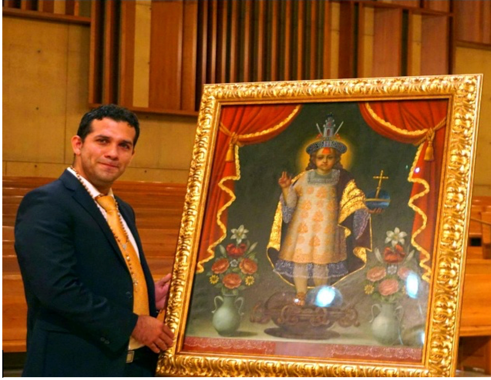
Alan A. Barrera
Independent researcher of the lexicon Ojalá
Master’s in Pan-Hispanic Linguistics (Universidad de La Sabana – Colombia)
Text Correction (Universidad del Salvador – Argentina)
Bachelor of Arts in Spanish Linguistics – Cal State University Dominguez Hills
Ministry of the Holy Child Inca of the Mascaypacha

Abjessü Valdiviezo
Independent researcher and Cultural Manager
Spanish Linguistics and Literature (Laureate Education – UNITEC; Mexico – United States)
Ministry of the Holy Child Inca of the Mascaypacha